BLACK SHEDDING(S)
Presented at Longwood Art Gallery, NY
Featured Artists: Gouled Ahmed, Nikesha Breeze, tasha dougé, Ehime Ora, Mikailah, and Jaleeca Yancy
Sound Production: Nicky Smith
Community Engagement: Nayah Harper
June 5th - July 10th 2024
Black Shedding(s) is a group exhibition first cultivated during 2020, and in conversation with the gathering, processing, and embodying of what it takes to shed a world that can no longer be. Black Shedding(s) focuses on curatorial research and reflection on Black diasporic culture and ceremonial practices of shedding on ancestral lands. Each Artists’ work is a reflection of the shedding process for liberatory transformation, centering the history of the lands we call home and the imagination for what is already here. Black Shedding(s) is a look at what exists inside the portal of transformation. The collaboration of each Artists' individual work comes together to tell a collective story. Through visual art, sound production, literary reflections, and educational resources, we invited the viewer into their own contemplation and conversation toward transformation.
Scroll down to view our community practice


EXHIBITION NARRATIVE
Upon entering the exhibit, a viewer is met with the work of Mikailah, whose intricate beadwork displays her signature style of beading contemporary nimîipuu Nation influenced work. Thompson is an Afro-Indigenous beadwork artist from the nimîipuu Nation, who learned the art of beading from her grandmother, Chloe Halfmoon. Mikailah’s “nimîipuu wall canvas” intentionally uses seed beads and brass throughout the 2-needle stitch. The viewer is looking at a traditional old-style color scheme commonly found within the tribe and a geometric pattern, allowing for the artwork to speak to its own transformation. Black Shedding(s) starts with Mikailah’s work as a grounding intention, understanding that to shed one must know what and who they are rooted in, in order to know what needs to be transformed. The history of Black Indigenous people in the United States is a sacred history that holds culture, values, and traditions in its art practices. Mikailah’s work starts the intention of the exhibition: who are you? What are you rooted in?
The viewer then moves to Nikesha Breeze, where her work “Land Effigy”, a sculpture built on-site using soil, cotton, flowers, willow branches, and found items, serves “as a guardian of Black, Indigenous, Queer and Earth bodies. Each one is constructed and initiated as a site-specific installation utilizing local plants and earth medicines. The Land Effigy becomes a grounding force for the work in the exhibit, utilizing the spirits of each plant to create both a field of protection and a conduit for the various energies that arise in the space.” In many Black, Indigenous, Queer, and Earth traditions, guardians are required to start any journey. They are there to guide as well as there to ground. Breeze’s work compliments the intention of Thompson’s, as the viewer explores the beginning of a transformation through full embodiment.
The curation of Black Shedding(s) was developed to tell a story, not linear by any means, but a story that is fluid like most are. The following work the viewer will see is a highlight in the exhibition, Nikesha Breeze’s first iteration of “108 Death Masks: A Communal Prayer for Peace and Justice”. [Currently a second edition is displayed as a permanent monument at the Freedom Monument Sculpture Park through the Equal Justice Initiative, where the masks have been developed into bronze.] The limited masks of her first edition series of the “108 Death Masks” forms a large-scale ceramic installation centered on the living experience of shared wound. Breeze shares that she “created 108 life-sized, hand-carved ceramic Death Masks as a ritual prayer for my lost and unknown ancestors. 108 is understood as a sacred number of endlessness and prayer. The number was used in this work to represent the endlessness of suffering in communities of color due to systematic racial violence, oppression and white supremacy. Simultaneously, it represents the endless capacity of prayer and conscious care to move backwards and forwards in time.” The artist invites viewers to take a single breath or hold a single prayer with each mask, uniting in 108 moments of silence and 108 prayers for peace, justice, and the end of violence and oppression worldwide. The masks are displayed for the viewer to both look directly at as well as be in communion with.
Directly facing Breeze’s masks, the viewer will see the work of Gouled Ahmed. Their ongoing self-portrait series “Our Earth Will Remember Us Again Someday” explores the gaps that exist within formal language in the understanding and contextualization of gender expressions that exist outside of the binary. In black and white portraits printed on soft white cotton paper, Ahmed highlights intricately textured garments from the Horn of Africa, as well as mixing contemporary and traditional materials to discuss the notion of futurity. Ahmed shares “I reflect on the unavailability of language to describe gender non conformity in both Somali and Amharic today. How I'm reduced to English to convey my sentiments, how so much is lost because of that.”
At the center, the viewer is encouraged to reflect on the depth of a shedding process: what was, is, and envisioning to become? Ahmed leaves us with the question “what would it mean for gender non-conformity not to have to be oriented toward transition (always having to go somewhere else, become something else, move on) but already as a legitimate (non-)destination?”.
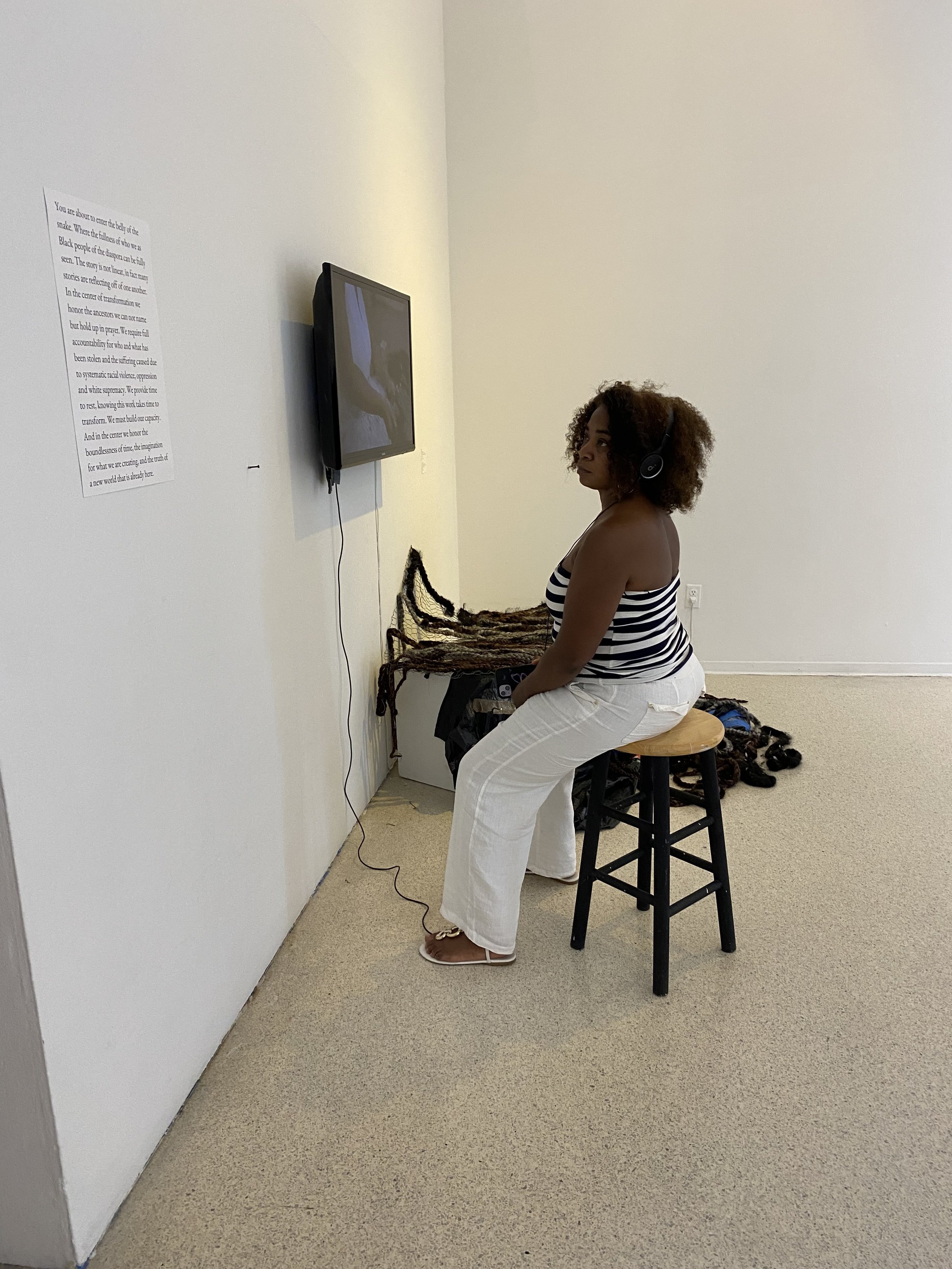
The exhibit continues with the work of tasha dougé. Depending on when the viewer sees the exhibit, they may view the structural bones of “Justice”, dougé’s 2016 sculpture work, that speaks to the history of enslavement in the United States. If the viewer enteres the exhibit after June 26th 2024, they will find the 2024 new edition of “Justice”. “Justice” went through its own shedding process which will be showcased and discussed on June 26th via a public performance and panel discussion. “Justice” more closely resembles Fourth of July streamers. Stripes of braided synthetic hair are unraveled and slumped away from their chicken wire anchor, cotton ball stars displaced from their canonical top-left hand mainstay and chicken-wire matrix laid bare.
Together, Artist and Curator, then seek to ask the viewer: What is the history of this land screaming for colonizers to be held accountable for? What are Black people shedding? Who are Black people becoming? Who have we always been? Emphasizing the complexities of the land, dougé puts in her longer statement “this piece serves as a reminder that the United States of America is what it is because of the contribution made by people of African descent. This country was built off the backs and labor of enslaved Africans. It was our blood, sweat, and tears that cultivated the soil of this rich land.”
The work of Ahmed, Breeze, and dougé, the fullness of what they are sharing individually and in conversation with each other, is held by an altar that was designed by Ehime Ora. Ora, designed this altar with the intention of reflection, grounded in her purpose of reconnecting others back to themselves as an educator of African Spirituality and holistic wellness. Through her creations, she facilitates tangible joy and spiritual well being within her communities. Ehime Ora is titled as Iyanifa (Ifa HighPriestess), Iya Sango (Sango Priestess), and Iya Erinle (Erinle Priestess). Ora offers her complementary wall installation, “The Return of Us” , using mirrors and photographs juxtaposed on an cosmogram. She shares “the center image was taken off the coast of Badagry, Nigeria—the point of no return for enslaved Africans. The igha-ede, or cosmogram, lies in the center and brings power to this moment—while the mirrors create echoes of new worlds and possible futures. The water always remembers, long after we forget. That’s why our ancestors are immortal.”
The final room in the shedding journey is designed as a place of home and remembrance. The home is a collective historic site for many Black people, as it is sometimes the only place available to do the spiritual shedding work Black people have been tasked to do. It is the guide and the grounding that brings the design of the exhibit into a spiral shedding shape.
The viewer will then see, Jaleeca Yancy’s “Pigment Series" and "The Secret Garden". The series began with a few key concepts: black hands meet textiles; upcycling found fabrics; and the ancestral influence of indigo. Yancy’s work displays living memory of the usage, practice, and history of upcycled fabrics and indigo amongst Black diaspora people. Yancy hand-dyed upcycled raw canvases with ethically-sourced, Moroccan indigo and saffron. The dyes mirror the vibrant resilience of the Black diaspora; the found fabrics speak to sustainability, which is the story of human innovation itself.
The exhibition end with Breeze’s complimenting video, “RE:TURN | RE: MEMBER”. The video is a 15 minute segment of Stages of Tectonic Blackness, an eight-hour durational performance and ritualized, elongated mourning dance for Black bodies and Earth bodies. “Conceptualized and directed by Breeze, the ritual performance followed multiple phases of ancestral offerings that were given throughout the 5,000 sq ft space, including salt, fire, water, rice, rum, incense and bells. The ritual culminated in a delicate and tender burial, unburial and washing ritual of four of the performers. The burial encapsulated the visceral reality of the continued death, disappearance and loss of life within Black, Indigenous, BIPOC and LGBTQIA+ communities. As each body was carefully unburied, brushed, washed and touched with deep loving care, the body-based grief was restructured into a form of re:memberance, putting back together the dismembered Black body as a whole, as a communal act of reclamation. The ritual washing was performed within Breeze’s sculptural boat entitled Arc of Return; the boat served as a ritual altar and Afrofuturist portal.”
As Curator, it was decided for the final room to be designed as a home to be quite literal of where the reality of the pandemic required us to do this work, in our homes.
Black Shedding(s) can be discussed alongside the works of: shedding light on/in, rebirth, infusion, transmutation, the science of chrysalis, to shed free from..., and snake medicine used in various different ways within various different spiritual traditions. It can be discussed amongst those of us who know that antiracist anticapitalist anticolonial Black Indigenous queer communal practice takes a communal shedding.
A shedding is different from a cleanse, a shedding is a transformation.
COMMUNITY PRACTICE
Opening night, the community was engaged in an activity exclusively designed for them by Nayah Harper. This activity served as our way to encourage people to collectively discuss the artwork and engage with the overview, materials, and intent of each artist’s work. We aim to make our openings both accessible and enjoyable.
This project included three free public programs that took place at The Longwood Art Gallery. We also made it a point to invite students from Hostos Community College, where the gallery is located.
Community Workshops